
If you logged into your analytics recently and felt your stomach drop at the traffic numbers, you are not alone. Google rolled out a significant core update last month, leaving a fair few business owners wondering what went wrong. The honest answer? For most sites, nothing went “wrong” at all.
This update was one of the more significant algorithm shifts we’ve seen so far in 2026, and at Kickstart Digital, we’ve been watching it closely. Here’s what we know, what it means for your business, and where to focus your energy from here.
What Actually Happened With This Update
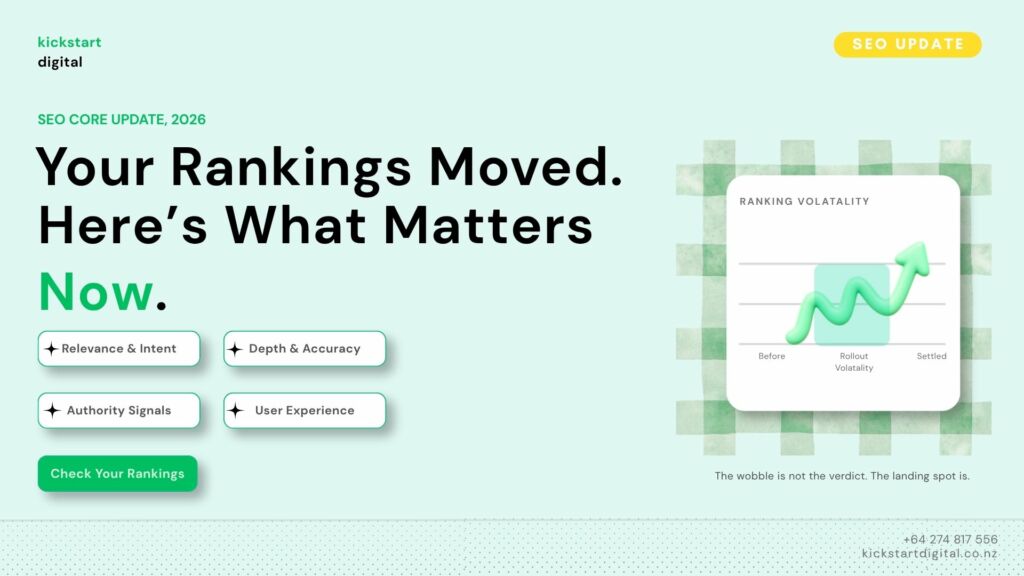
Google’s latest algorithm update rolled out over roughly 12 days. Industry tracking tools flagged high volatility at several points during the rollout, and many SEO professionals noted it hit harder than the core update we saw earlier in the year
A Google core update is not a targeted penalty. It’s a broad reassessment of how Google evaluates content quality, relevance, and trustworthiness across every website on the web, all at once. Think of it as Google reshuffling the deck, not singling anyone out.
The key things to understand:
- It affected every region and every industry globally
- Sites can move up or down, and many barely shift at all
- Drops do not mean your site has been penalised or that you’ve broken any rules
- The update is designed to surface content that Google believes better serves the person searching
If your rankings moved, it most likely means a competing page is now being rated more highly for a particular search, not that your site has developed a technical fault. That distinction is important because it changes what you should actually do next.
Who Felt It Most
Core updates tend to hit hardest in areas where content quality is inconsistent or where pages have been built around keywords rather than genuine usefulness. Sites that leaned heavily on thin content, lacked clear expertise signals, or hadn’t kept their pages current and accurate were more exposed.
On the flip side, sites with a strong track record of answering their audience’s real questions, written by people who clearly know their industry, tended to hold ground or even gain positions. This is a pattern we’ve seen play out with every major Google algorithm update over the past few years, and 2026 is no different.
The businesses that sailed through relatively unscathed? They weren’t doing anything flashy. They just had content that people actually found useful, well-structured websites, and a consistent approach to SEO in Auckland that prioritised their audience over the algorithm.
What Google Is Actually Rewarding
People assume Google’s updates are about technical tricks, keyword density, or some new ranking factor they haven’t discovered yet. In reality, the direction has been consistent for years. Google is trying to get better at identifying the pages that would genuinely satisfy the person searching.
That comes down to a few core things:
Relevance and intent. Does your page actually answer what the user is searching for, not just contain the words they typed? There’s a real difference between a page that mentions a topic and a page that addresses it properly.
Depth and accuracy. Shallow content that skims the surface has been losing ground to pages that go into real detail. This doesn’t mean writing longer for its own sake. It means covering a topic well enough that the reader doesn’t need to go back to Google to find out more.
Authority signals. Who’s behind the content? Are there clear signs of expertise, whether that’s credentials, case studies, industry experience, or consistent publishing history? Google has been placing increasing weight on these signals since its helpful content systems came into play a few years back.
User experience. If people arrive on your page and immediately leave, that tells Google something. Page speed, mobile usability, and how intuitive your site is to navigate all feed into how your pages perform. This is an area where website development in Auckland can make a measurable difference to your search visibility.
What Not to Do Right Now
The worst thing you can do after a core update is panic and start making sweeping changes. If you’ve already spotted a drop and are tempted to rip pages apart, hold off. Rankings tend to keep adjusting for a couple of weeks even after a rollout wraps up, and reacting too quickly usually means reacting to noise rather than signal.
Give things a bit more time to settle before concluding. Then dig into the patterns. Look at where you’ve lost ground, what search terms took a hit, and whether it’s a consistent trend or just a couple of outliers. One rough week rarely tells the full story.
It’s also worth keeping in mind that this update overlapped with Google’s expansion of its AI-powered search features, which makes the picture slightly harder to read. Some visibility changes may reflect how your content is being surfaced in AI summaries, not just traditional rankings, so it pays to look at the full picture before making any calls.
How to Read Your Own Data
If you want to understand what actually happened to your site, here’s a sensible starting point:
Compare the week after the update fully settled with the week before it began. That gives you a clean before-and-after without the mid-rollout turbulence getting in the way.
Look at which pages dropped and what they have in common. Are they older pages that haven’t been updated in a while? Are they covering topics where competitors have produced more thorough content? Understanding the pattern is far more useful than trying to fix individual pages at random.
Tracking your keyword positions consistently is something we help our clients with through growth tracking and analytics. When you have visibility into how your rankings move week to week, you’re not flying blind when an update like this hits. You can see what shifted, what stayed steady, and where the real opportunities are.
Building a Site That Weathers Any Update
This isn’t the last core update you’ll see in 2026. Google refreshes its systems regularly, and waiting for things to calm down permanently isn’t a strategy.
What does work is building the kind of online presence that holds up regardless. Content with genuine depth, a website that works well for visitors, clear signals of expertise, and a long-term approach to digital marketing that treats SEO as an investment rather than a quick fix. That’s what actually moves the needle.
If you’d like a proper look at where your site stands, get in touch with the Kickstart Digital team. We work with businesses across New Zealand to build search visibility that lasts.