
Most businesses publishing on social media are producing content that gets seen once and forgotten. The post goes live, gets a handful of likes, and disappears into the feed within hours. Yet other brands, often with smaller followings, are consistently generating saves, shares, and return visits from the same audience.
The difference is not frequency, budget, or even design quality. It comes down to understanding the psychology behind why people save and share content and building that understanding into every post before you write a single word.
This guide breaks down exactly how to do that.
Why Do People Save Content?
Saving a post is a deeply psychological act. When someone taps that bookmark icon, they are essentially signalling: “This is useful, and I don’t want to lose it.”
They are not saving it because they liked it. They are saving it because they plan to use it later.That distinction changes everything about how you should create content.
People save content for four core reasons:
1. Future utility – “I’ll need this when I’m ready.” A recipe, a how-to guide, a checklist, a template. It’s practical and time-relevant.
2. Aspiration – “This is who I want to become.” Transformation posts, before-and-afters, dream outcomes. The save is a vote for their future self.
3. Identity reinforcement – “This says something true about me.” When content articulates something a person already believes but couldn’t put into words, saving it feels like claiming it.
4. Fear of missing out on value – “I can’t process this right now, but I don’t want to lose it.” Long-form, high-density content gets saved precisely because it is too valuable to scroll past and too detailed to absorb in the moment.
When you understand these four triggers, you stop creating content to impress people and start creating to serve them. That is the shift that turns scroll-past posts into saves.
Why Do People Share Content?
Shares are different from saves. Where a save is private (“I want this”), a share is social (“I want you to see this”).People share content when it makes them look good, informed, thoughtful, ahead of the curve, or generous with their knowledge. A share is essentially self-expression by proxy.
They also share when content does the emotional work they couldn’t do themselves. A post that perfectly articulates a frustration, celebrates something meaningful, or explains a complex idea in plain language becomes shareable because it says what people feel but cannot put into words.
At Kickstart Digital, we encourage clients to ask one question before publishing anything, “Would someone want to be seen sharing this?” If the answer is no, the content needs reworking.This is why social media content strategy matters so much. It is not about posting more. It is about posting with intention.
The Anatomy of a Save-Worthy Hook
If your hook does not stop the scroll, nothing else matters.
On Instagram, TikTok, LinkedIn, and Facebook, you have less than two seconds to earn someone’s attention before they move on. The hook, whether that is your opening line, your headline, or your first frame, carries the full weight of that moment.
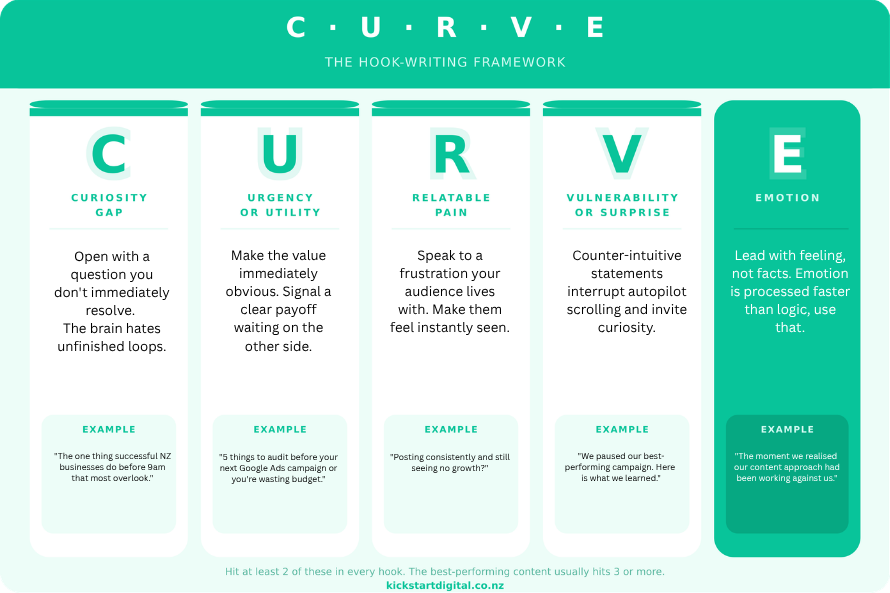
Here is a framework we use called C.U.R.V.E. for writing hooks that consistently perform.
C — Curiosity Gap
Open with a question or statement you do not immediately resolve. “The one thing successful NZ business owners do before 9am that most people overlook.” The brain is wired to seek closure. An unfinished loop keeps people reading.
U — Urgency or Utility
Make the value immediately obvious. “5 things to audit before your next Google Ads campaign (or you’re wasting budget).” Utility-forward hooks are highly saveable because they signal a clear payoff waiting on the other side.
R — Relatable Pain
Speak directly to a frustration your audience lives with. “Posting consistently and still seeing no growth?” When someone reads that and immediately recognises themselves, you have their full attention.
V — Vulnerability or Surprise
Counter-intuitive statements and candid admissions are natural scroll-stoppers. “We paused our best-performing campaign. Here is what we learned.” Unexpected angles interrupt autopilot scrolling behaviour and invite curiosity.
E — Emotion
Lead with feeling rather than information. Emotion is processed faster than logic, and it is what keeps people reading. “The moment we realised our entire content approach had been working against us.” A story that opens mid-emotion creates immediate pull.
You do not need all five elements in every hook. However, the best-performing content almost always hits at least two.
Humanising Your Content: The Real Differentiator
No algorithm update, posting schedule, or design template replaces genuine human perspective.
Tools can generate content. Platforms can distribute it. But the reason someone saves your post at 11pm, returns to your profile the next day, and eventually becomes a client is you, your point of view, your experience, and the way you explain things that nobody else explains quite the same way.
Humanised content is built on three principles:
Specificity over generality. “We increased a client’s organic reach by 340% in six weeks by changing one element of their content format” outperforms “Here are some tips to grow on social media.” Specific, verifiable detail builds credibility and earns saves.
Earned insight, not recycled advice. Share what your team has genuinely learned from client work, failed campaigns, and unexpected results. Recycled content is abundant. Original perspective is what gets bookmarked.
A tone that sounds like a person. Read your copy aloud before publishing. If it sounds like a brochure, rewrite it until it sounds like a conversation. People connect with people, not corporate language..
Putting It Together: The Save-Worthy Content Formula
Here is the structure that brings everything above into a repeatable format:
Hook → Relatable Problem → Specific Insight → Actionable Payoff → Call to Save
The call to save is one of the most underutilised tools in content marketing. Simply prompting your audience with “Save this for later” or “Bookmark this before you need it” measurably increases save rates. People often need a direct invitation to take that action.
For shares, end with something people genuinely want to be associated with, a clear takeaway, a reframed perspective, or a statement that articulates something your audience has long believed but never seen said so plainly.
Your Next Post Is the Practice Ground
Pick one post you are planning this week. Before you write the caption, run your hook through C.U.R.V.E. Ask whether the body serves the reader’s future self or just fills space. Then end with a direct call to save.
That one post will not go viral. But it will be better than the last one. And the post after that will be better still. Save-worthy content is not a single breakthrough. It is a standard you set and keep raising.
The brands winning on social media right now are not doing something exotic. They are being more deliberate, more specific, and more useful than everyone else in their feed.
Want help developing a content strategy that builds your audience and drives real business results? The team at Kickstart Digital works with New Zealand businesses to create digital marketing systems that convert.