
At Kickstart Digital, we have had this conversation more times than we can count. A business owner comes to us, slightly frustrated, having spent money on either Google Ads or SEO, and somewhere along the way, things did not quite go to plan. Either they poured budget into paid ads and saw results dry up the moment they paused spending, or they invested months into organic search and grew impatient waiting for rankings to move. The truth is, both of these outcomes often come down to one simple problem: using the right tool at the wrong time.
We are a performance marketing agency based in Auckland, and helping businesses figure out exactly where to put their digital marketing dollars is very much at the heart of what we do. This guide is our attempt to cut through the noise and give you a straightforward, honest look at Google Ads versus SEO, when each one makes sense, and why the smartest businesses are rarely using just one or the other.
Understanding the Difference (Without the Jargon)
Before we get into strategy, it helps to be clear on what we are actually talking about.
SEO (Search Engine Optimisation) is essentially about making your website the kind of result Google wants to show people, without you having to pay for that placement. Picture someone searching for a plumber in Auckland and scrolling past the ads to click on one of the results below. That business earned its spot there through SEO, not through a daily ad budget. It is built on content, technical website health, and the credibility your site earns over time through backlinks and relevance.
You can explore more about how we approach this through our SEO services in Auckland.
Google Ads (also called PPC or pay-per-click) is exactly what it sounds like: you pay Google every time someone clicks on your advertisement, which appears at the top or bottom of the search results page. There is no waiting around. The moment your campaign goes live and your budget is active, your business is visible. Learn more about how we structure these campaigns on our Google Ads page.
Both approaches are chasing the same thing: getting the right people to find your business online. They just go about it in very different ways, on very different timelines, and with very different cost structures.
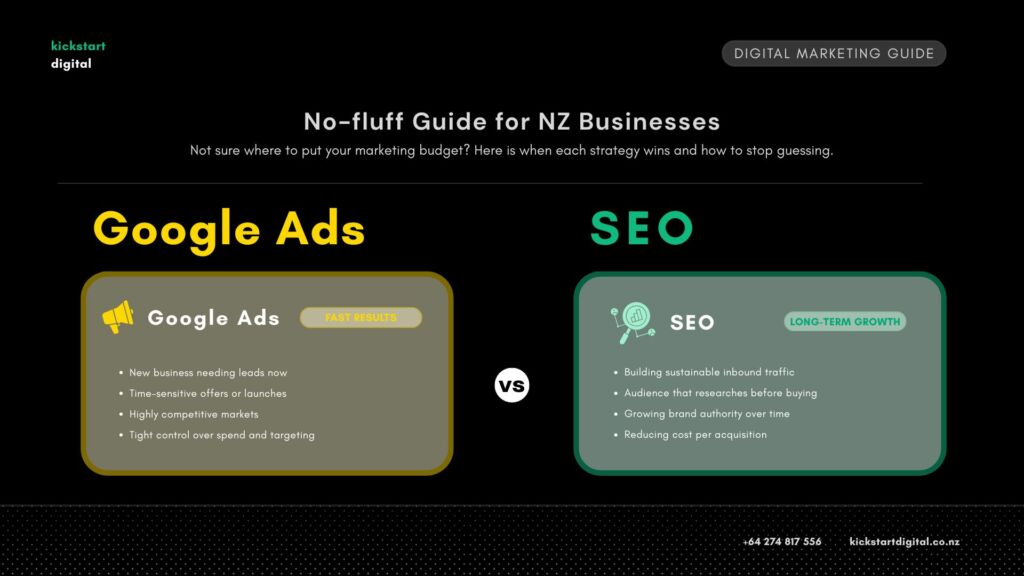
When Google Ads Makes More Sense
If you need results quickly, paid search is usually the more practical starting point. There is no beating around the bush here. SEO is a long game, and if your business needs leads flowing in within the next few weeks, waiting six months for organic rankings to climb is simply not a viable strategy.
Here are the situations where leaning into Google Ads tends to pay off:
You have just launched a new business or website. A brand-new website is a bit of an unknown quantity in Google’s eyes. It has no track record, no history of ranking, and no backlinks vouching for its credibility yet, so asking it to compete organically from day one is a tough ask. Running Google Ads during this early stage keeps the enquiries coming in while your SEO foundation is steadily being laid.
You are promoting something time-sensitive. A seasonal sale, a product launch, a limited-time offer: these all need traffic now, not later. The immediacy of PPC (pay-per-click advertising) is genuinely hard to replace in these scenarios.
You are in a highly competitive market. Certain industries, particularly legal, financial, and medical services, have organic search results dominated by well-established sites that have been building authority for years. It can take a very long time to compete organically. A well-structured Google Ads campaign lets you show up right alongside those competitors today.
You want tight control over your spending and targeting. With Google Ads, you can dial in exactly which searches trigger your ads, what geographic areas they appear in, what time of day they run, and how much you spend. That level of precision is genuinely useful for testing what messaging resonates with your audience before committing to a longer content strategy.
The catch, of course, is that the moment your budget runs out, so does your visibility. Paid search is like renting a shop on the high street: it is great while you are paying for it, but you do not own anything when the lease ends.
When SEO Is the Smarter Investment
Organic search, done well, is one of the best long-term investments a business can make. The results compound over time in a way that paid advertising simply cannot replicate. A well-ranking page can bring in qualified traffic for years without an ongoing cost per click.
SEO tends to win in the following situations:
You are building a business for the long haul. If you are thinking beyond the next quarter and want a sustainable pipeline of inbound enquiries that does not rely entirely on an ad budget, organic search is where you want to be putting your energy. The upfront investment in content and technical optimisation pays dividends well into the future.
Your audience does a lot of research before buying. Not every customer is ready to purchase the moment they hit your website. Many people search for information, compare options, and read around a topic before making a decision. SEO lets you show up at every stage of that journey, building trust and familiarity long before someone is ready to convert.
You want to build genuine brand authority. Ranking organically for competitive terms signals credibility in a way that paid ads simply cannot. Most users know that the ads at the top are paid placements. Earning your way into the top organic results carries a different kind of weight.
Your cost per acquisition through paid ads is too high. In some industries, the cost per click in Google Ads can be eye-watering, making it difficult to run profitable campaigns. SEO offers a way to generate traffic without the recurring cost attached to every single visitor.
It is worth being honest about the timeline, though. Meaningful SEO results typically take anywhere from three to six months to begin showing up, and in competitive spaces, it can take considerably longer. Patience is not optional here; it is simply part of the deal.
Our growth tracking and analytics service is particularly valuable during this phase, as it helps us keep a close eye on what is moving and adjust the strategy accordingly.
The Case for Using Both Together
Most businesses approach this as a choice between one or the other, and that is usually where they short-change themselves. The two strategies actually feed into each other in ways that are genuinely useful. Running paid campaigns, for instance, surfaces real conversion data fairly quickly, showing you which search terms are actually bringing in customers rather than just curious browsers. That kind of insight takes the guesswork out of your SEO content plan entirely.
Equally, as your organic rankings improve and you start earning consistent traffic from SEO, you can pull back your ad spend on those keywords and redirect that budget toward terms where you are not yet ranking. The two strategies end up complementing each other rather than competing.
For many of our clients here at Kickstart Digital, the most effective approach has been to lead with Google Ads to generate early momentum and gather data, then layer in a structured SEO strategy to build long-term visibility. Over time, the reliance on paid spend decreases as organic traffic picks up the slack.
Common Mistakes We See Businesses Make
Since we work with businesses across a range of industries in New Zealand, we have seen the same mistakes come up again and again, and it would feel remiss not to flag them here.
Expecting SEO to work overnight. It simply does not, and anyone who promises otherwise is cheating you. Organic search takes time, and businesses that abandon their SEO strategy after two or three months because they are not yet seeing results tend to repeat this cycle indefinitely, never getting far enough along to reap the rewards.
Running Google Ads without a properly set-up tracking system. If you cannot see which of your ads are generating leads and which are burning through the budget without results, you are essentially flying blind. Making sure your analytics and conversion tracking are set up correctly before spending money is non-negotiable, and it is something we pay very close attention to with every client we work with.
Going too broad with both approaches. Trying to rank for every possible keyword, or running ads against every conceivable search term, spreads your resources too thin. Focus matters enormously, particularly in the early stages.
Neglecting the website itself. Both paid and organic search will drive traffic to your site, but if that traffic lands on a slow, confusing, or visually dated website, it will not convert. Strong website development underpins everything, and a weak site will undermine even the best-run campaigns.
So, Which One Should You Choose?
If you are just starting and need results fast, start with Google Ads and build your SEO strategy alongside it. If you are a more established business with a reasonable amount of existing traffic and a longer planning horizon, SEO deserves a significant share of your investment. And if your budget allows, running both with a joined-up strategy is almost always the most effective path forward.
The honest answer is that there is no universal right choice here. Every business is sitting in a different position, with a different runway, different competition, and different goals, so the right starting point genuinely varies. What we have seen consistently across the clients we work with, though, is that the ones who approach digital marketing as something they refine and build on over time, rather than something they set up once and leave alone, are the ones who tend to outpace their competitors in the long run.
If you are unsure where to start, or if you have been going at it alone and not quite getting the traction you were hoping for, we are always happy to have a conversation.
Get in touch with our team and let us take a proper look at what is working, what is not, and where the best opportunities are for your business right now.