
Google Ads has changed considerably over the past few years, and much of that change points in one direction: more automation, more machine learning, and less hands-on control for the advertiser. Performance Max campaigns sit right at the centre of that evolution, and they have quickly become one of the most talked-about campaign types in the industry.
At Kickstart Digital, a performance-focused digital marketing agency based in Auckland, we field questions about Performance Max from businesses of all sizes, and the same theme comes up every time: people want to know whether it actually works, and whether it is right for them. This guide covers everything you need to make that call with confidence.
What Are Performance Max Campaigns?
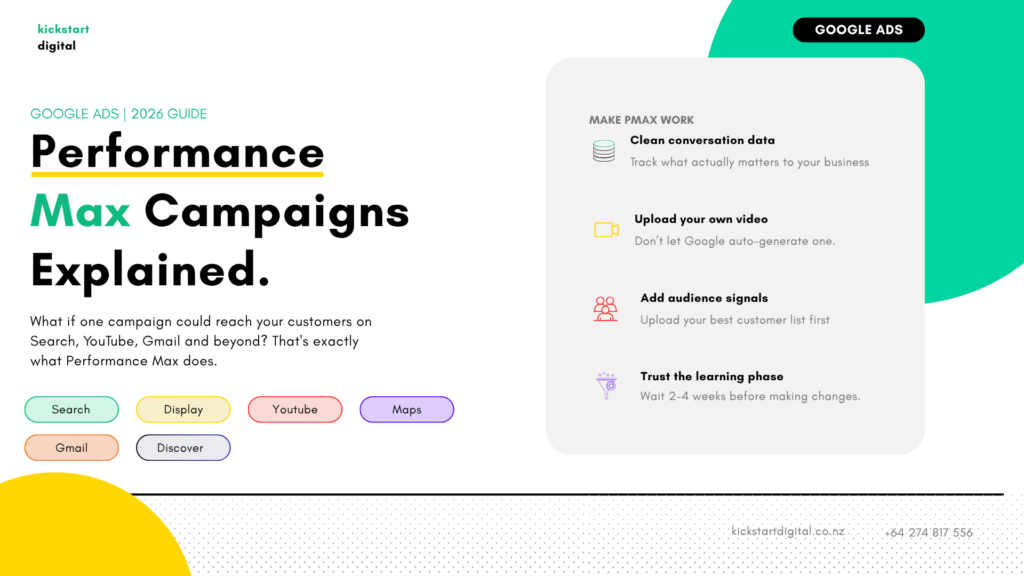
Google Performance Max, often referred to simply as PMax, is a goal-based campaign type rolled out broadly in 2021 that has since become one of Google’s primary campaign formats. Unlike traditional campaign types, where you choose a specific channel, such as Search, Display, or YouTube, a Performance Max campaign runs across all of Google’s inventory simultaneously, including Google Search, the Display Network, YouTube, Gmail, Google Maps, and Google Discover, all from within a single campaign.
Rather than the advertiser selecting specific placements, Google’s algorithms assess signals in real time and decide which channels and audiences are most likely to produce a conversion at that particular moment, shifting budget accordingly. You provide the creative assets, the audience signals, and the conversion goals, and the system takes it from there. For advertisers who have spent years managing campaigns at a keyword and placement level, this represents a fairly significant change in working method, which is why opinions on PMax tend to be split down the middle.
How Google Performance Max Works Under the Hood
A good place to start with the Performance Max strategy is understanding what actually happens after you hit publish on a campaign. Unlike standard campaign types, PMax does not use individual ads in the way most advertisers are used to. Instead, you build what Google calls an Asset Group, which is a collection of creative inputs, including headlines, descriptions, images, logos, and videos. Google pulls from that collection and assembles ad combinations dynamically, running different variations across different channels to identify what is generating results.
Underpinning all of this is Smart Bidding, a system that draws on your account’s conversion data to adjust bids in real time based on contextual signals such as device type, location, time of day, and browsing history. Because the whole system is driven by conversion data, having reliable growth tracking and analytics in place before you launch is not optional. Feed the algorithm inaccurate or incomplete data, and it will spend your budget optimising toward outcomes that do not actually reflect your business goals.
The Role of Audience Signals
Audience signals are another area where PMax campaigns are frequently misunderstood. When building a campaign, you have the option to provide audience signals, which are inputs that tell Google something about the kinds of people most likely to convert for your business. These might take the form of customer match lists, website visitor segments, or relevant in-market audiences.
It is important to understand that these are signals, not targeting restrictions. Google will use them as a starting point and then expand beyond them if the algorithm identifies conversion opportunities elsewhere. Providing high-quality audience signals, particularly by uploading a customer list of your best existing customers, tends to give the algorithm a much better foundation to work from. Think of it as pointing the system in the right direction rather than drawing a hard boundary around who it can reach.
Building a Solid Performance Max Strategy
Going into a PMax campaign without a strategy is a bit like setting off on a road trip without a map. The car might get you somewhere, but not necessarily where you intended to go. Here is what a thoughtful Performance Max strategy looks like in practice.
Start with clean conversion data. Before anything else, make sure your conversion actions are set up correctly and that you are tracking outcomes that actually matter to your business, whether that is a phone call, a form submission, or a purchase. Poor conversion data is the single biggest reason Performance Max campaigns underperform.
Invest in your creative assets, and always upload your own video. Because the algorithm assembles your ads from the assets you provide, their quality has a direct impact on performance. Aim for a full range of headlines, descriptions, and images rather than the bare minimum. Video is where many advertisers make a costly mistake: if you do not upload a video asset, Google will automatically generate one from your still images. These auto-generated videos are almost always of poor quality and will represent your brand across YouTube and Display placements, whether you like it or not. Even a simple, well-branded product showcase or short explainer gives you far more control and tends to improve performance meaningfully.
Use URL expansion thoughtfully. PMax campaigns have a feature called URL expansion, which allows Google to send traffic to any page on your website it considers relevant, rather than just your specified landing page. This works well if your website is well-structured and conversion-optimised, but it can backfire if your site has thin pages or a poor user experience. A well-developed website solution underpins the success of any paid campaign.
Monitor your search themes and search term insights. PMax does not offer the same keyword-level visibility as a standard Search campaign, but Google does surface search term insights within the reporting tab. Checking this regularly gives you a clearer picture of the kinds of queries triggering your ads, which in turn helps you assess whether the campaign is pulling in traffic that is genuinely relevant to what you offer.
Layer your PMax with existing Search campaigns. If you are already running standard Search campaigns, Google’s guidance is that if an exact match keyword in a Search campaign matches a user’s query, the Search campaign will take priority. Keeping brand keywords protected in a separate Search campaign is generally good practice.
When Performance Max Works Best
Businesses that tend to get the most out of PMax are those with a decent volume of conversion history already sitting in their accounts, a healthy range of creative assets to draw from, and a campaign goal that is clearly defined rather than spread across several different objectives. E-commerce businesses with active product catalogues are a natural fit, as are service businesses that have been running Google Ads long enough to have built a meaningful data foundation. If you are new to Google Ads and your account is relatively thin on conversion data, PMax will likely struggle in the early stages, and you will generally get better traction by building that foundation through Search campaigns first.
For businesses competing in local markets, running Performance Max alongside a strong SEO strategy is worth considering. Paid and organic work well together in these environments, with ads driving visibility in the short term while search rankings build over time.
Common Pitfalls to Watch Out For
Even well-intentioned campaigns can fall short with PMax if a few common mistakes creep in. Setting an unrealistic target CPA or ROAS from the outset is one of the most common, because it constrains the algorithm’s ability to gather enough data to optimise. Launching with a budget that is too small is another, as PMax needs a certain level of spend to generate the learning signals required for Smart Bidding to function effectively.
Creative assets also need attention once the campaign is live. Leaving your asset group untouched for months on end is a missed opportunity. Refreshing headlines and images periodically, and adjusting messaging to reflect promotions or seasonal changes, gives the algorithm more to work with and keeps the campaign from going stale.
How Long Does It Take to See Results from Performance Max?
Businesses often want a straight answer to this before they commit, and rightly so. When you first launch a PMax campaign, Google enters a learning phase where the algorithm tests different asset combinations, placements, and audience signals to understand what works. This typically lasts two to four weeks, and during that window, you will often see erratic performance and costs that feel inflated. That is normal behaviour, and making major changes or pausing the campaign during this period is one of the most common and costly mistakes advertisers make.
Meaningful optimisation generally continues building over the first 60 to 90 days. A useful benchmark: PMax tends to perform most reliably once an account is generating at least 30 conversions per month, giving the algorithm enough signal to make confident bidding decisions. If you are well below that threshold, building conversion history through a standard Search campaign first is usually the smarter path.
FAQs
Do Performance Max campaigns replace Search campaigns?
Not exactly. Google positions PMax as a complement to Search rather than a replacement. If you have exact match keywords in a Search campaign that match a user’s query, that Search campaign will generally take priority in the auction. The two campaign types can and often should run alongside each other, with Search handling high-intent branded and core keywords while PMax works to find incremental conversions across the broader Google network.
How much budget do I need for Performance Max to work effectively?
There is no fixed minimum, but campaigns on very limited budgets tend to struggle because the algorithm cannot generate enough data to optimise Smart Bidding properly. Most practitioners recommend at least $1,500 to $2,000 per month to give the campaign a realistic chance of clearing the learning phase and producing reliable results. Below that level, a focused Search campaign will typically serve you better while you build toward a point where PMax makes sense.
Can I control where my Performance Max ads appear?
To a degree. You can exclude specific URLs, topics, and content categories at the account level, and those carry through to PMax. However, you cannot choose specific placements or channels the way you can in a standard Display or YouTube campaign. Where your budget actually goes is determined by Google, based on where the system judges conversions to be most likely at any given time, and that reduced visibility is one of the genuine trade-offs you accept with PMax.
Is Performance Max Right for Your Business?
Google Performance Max campaigns have real merit, but they reward businesses that go in prepared. Clear conversion goals, quality creative assets, and reliable tracking data are what separate campaigns that gain traction from those that burn through budget without much to show for it. Automation handles a lot of the heavy lifting, but it still needs good inputs to work from, and the strategic thinking behind a campaign remains as important as ever.
If you are considering Performance Max for the first time, or your current campaigns are not delivering what you expected, get in touch with the team at Kickstart Digital.
We are happy to take a look at where things stand and work out what makes sense for your account.