
Most Google Ads accounts are still being built the same way they were five years ago: someone does keyword research, groups terms by theme, writes a handful of ads, and sends all that traffic to the homepage or a generic landing page. It is a process that feels logical on the surface, but in 2026, this approach is quietly draining the budget from New Zealand businesses that deserve far better results.
Here is what Google will not spell out for you: it stopped being a simple keyword-matching engine quite some time ago, and it is now operating far more like an intent-reading machine that evaluates context, user behaviour, and the full picture of what someone is trying to accomplish when they type a query. If your campaigns have not caught up to that reality, you are already behind the eight ball, and the gap only widens as automation becomes more central to how the platform works.
This is exactly where search intent mapping stops being a buzzword and starts being a genuine business necessity for anyone serious about Google Ads performance.
What Search Intent Mapping Actually Means in a PPC Context
Search intent mapping, at its core, is the process of understanding why someone is searching, not just what words they happen to be typing into Google at that moment. In the context of paid search, it means structuring your campaigns around the actual goal sitting behind a query, so that your ad copy, your landing page, and your bid strategy are all working in step with where that person is in their decision-making journey.
It is important to be clear that this is not simply keyword grouping with a fancier name. Two people can type nearly identical phrases and be in completely different headspaces, with completely different expectations of what they want to find. “Running shoes NZ” from someone doing casual early research is a world apart from the same phrase typed by someone who has already compared three brands and is now looking for the final push to purchase. Same words, very different intent, and a very different outcome if you treat them as the same audience and send them to the same page.
This disconnect between what a keyword technically matches and what the searcher actually wants is what creates wasted spend in otherwise well-run accounts, and closing that gap is where the real performance improvements tend to live.
The Four Intent Types and Why Each One Demands a Different Response
Search intent broadly falls into four categories, but what matters in Google Ads is not simply being able to name them. It is knowing what each one requires from your campaign structure, your creative, and your landing page experience.
Informational intent covers queries like “how does a water purifier work” or “why does my tap water smell,” where the person is in research mode and nowhere near ready to buy. Bidding aggressively on these queries with a hard-sell product page is money out the window, because the intent and the experience are completely misaligned. A helpful resource, a softer call to action, or a remarketing trigger tends to serve this stage far better.
Commercial intent is where things get interesting, covering queries like “best shampoo for frizzy hair NZ 2026,” where the person is actively comparing options and sitting much closer to a decision. A well-structured comparison page or a category page that answers the questions a buyer at this stage would naturally have is your strongest asset here.
Transactional intent is your clearest buying signal, covering phrases like “buy shoes NZ,” where the person knows what they want and is ready to act. This is the intent type that connects most directly to revenue, and it deserves a landing page that removes every possible obstacle between the searcher and the conversion.
Navigational intent covers brand-specific searches, where someone is looking for you or a competitor by name. If you are not protecting your own brand terms, there is a very real chance a competitor is bidding on them and capturing traffic that should have been yours without a second thought.
Why Traditional Keyword Structure Is No Longer Doing the Job
For years, the gold standard of Google Ads management revolved around tight control, exact keyword match, tightly themed ad groups, granular manual bids, and a clear sense that you knew exactly what you were paying for and why. That level of control felt like a feature, and in many ways it was.
That era has largely passed, and the accounts that are still operating as though it has not are the ones seeing budget leakage they cannot quite explain, conversion rates that do not match their click-through rates, and a nagging sense that the platform is working against them rather than with them.
Google’s systems now interpret query context, factor in user behaviour signals, and draw on patterns across enormous volumes of search data to decide which ads to show and to whom. Exact match no longer means what it once did, and broad match paired with smart bidding can genuinely outperform a tightly controlled setup, but only when the intent structure underneath the campaigns is clean and clearly defined. When that structure is muddled, the algorithm works with poor information and makes expensive decisions accordingly.
If you are curious about how smart bidding and automation fit into a well-built Google Ads strategy, the architecture sitting underneath your campaigns will always matter more than the budget sitting on top of them.
How to Map Search Intent Inside Your Google Ads Account
The good news is that intent mapping is not an abstract exercise. It is a practical process that starts with data you already have access to and builds into a campaign structure that works with the way Google’s systems operate rather than against them.
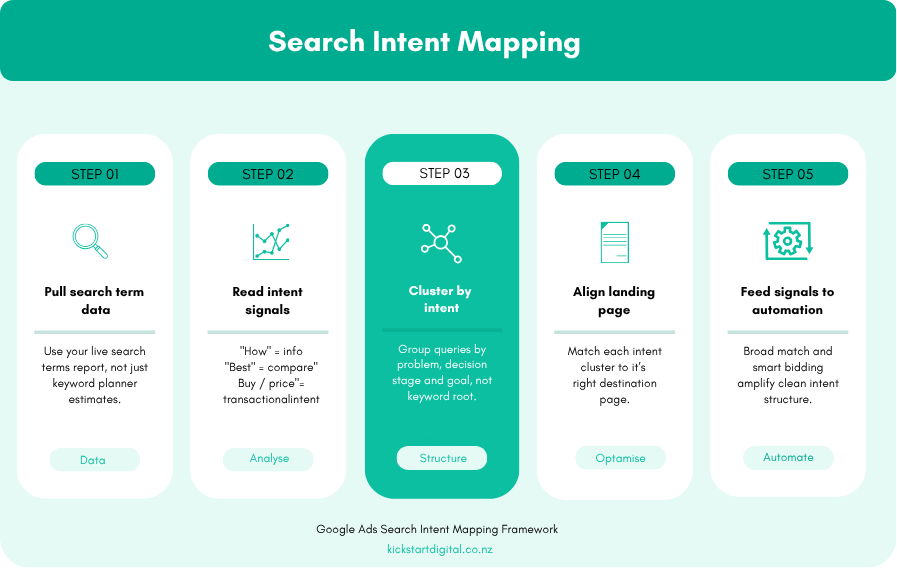
The first step is pulling your real search term data, not keyword planner estimates or assumptions. Still, the actual search terms report inside your Google Ads account, which shows you what people are genuinely typing before they land on your ad, is often full of patterns you would never have anticipated from keyword research alone.
From there, the job is to read the intent signals embedded in the language people are using. Words like “how” and “what” signal information-seeking behaviour. Words like “best” and “top” signal someone who is actively comparing. Words like “buy,” “price,” “near me,” and “specific location” appended to a query signal purchase readiness, and that distinction should directly shape how you structure your campaigns and what you show those people when they arrive.
The structural shift that tends to have the biggest impact is clustering by intent rather than by keyword, so that instead of grouping “shoes” and “buy shoes” together because they share a root word, you separate them into distinct campaigns that serve different audiences at different stages with different messages and different destinations.
That destination piece is where most accounts leave significant performance on the table, because sending a “best water purifier NZ” searcher to a product page with no comparison information is like handing someone a map when they asked for directions. The intent does not match, the bounce rate climbs, and Google’s quality score takes note. Landing page alignment is one of the most powerful levers in conversion rate optimisation, and it starts with getting the intent right before the click ever happens.
Finally, once your intent structure is clean, you feed those signals into automation with confidence, because broad match and smart bidding genuinely amplify whatever structure sits beneath them. Clear intent structure delivers better results, while a vague or mixed structure simply delivers faster and more expensive confusion.
Mistakes That Are Costing Businesses More Than They Realise
Even well-run accounts fall into patterns that quietly erode performance over time. Treating intent as a simple labelling exercise rather than a structural discipline is one of the most common, because the value is not in knowing the four categories but in building campaigns that reflect them at every level. Mixing multiple intents inside a single ad group is another, because it forces the algorithm to make compromises that serve no one particularly well. Routing all traffic to the same landing page regardless of where someone is in their journey is perhaps the most expensive habit of all, and one that tends to persist simply because fixing it requires effort that feels disconnected from the ads themselves. Ignoring mid-funnel queries is a particularly costly oversight, because commercial intent traffic is often where the highest-value conversions are waiting, overlooked in favour of the obvious transactional terms everyone is already competing for.
Where Google Ads Is Heading and How to Stay in Front of It
Search in 2026 is becoming increasingly conversational, with queries growing longer, more contextual, and more nuanced as people interact with AI-powered search experiences that reward relevance in ways that keyword matching alone was never built to deliver. Performance Max is expanding the surface area across which your ads can appear, and AI overviews are reshaping what a search results page even looks like for a growing proportion of queries.
Through all of that change, one principle remains constant: the advertiser who understands what their audience actually wants will consistently outperform the one who simply bids on the right words. For businesses competing in increasingly crowded digital spaces, a new PPC strategy that is genuinely rooted in intent mapping is not a refinement you get around to eventually. It is the difference between a campaign that treads water and one that actually earns its place in your marketing budget.
The Bottom Line
Winning at Google Ads is no longer about finding better keywords. It is about understanding intent clearly and completely more than anyone else competing for the same audience, and then building every layer of your campaigns around that understanding, from the structure and the copy right through to where you send people when they arrive.
If your current campaigns have not been reviewed through the lens of search intent, there is a strong chance they are working considerably harder than they need to for considerably less return than they should be delivering.
Get in touch with the Kickstart Digital team today, and we’ll help you align your campaigns with real user intent to unlock efficient spend and stronger, consistent results.